Wednesday, September 4, 2013

Philosophy of the Vedas

It is generally believed that “Religion begins where Science ends”.  But let me change this phrase a bit and say, “Philosophy starts where Science ends”. Now, come let us have a look at the various Philosophical schools of thought, on what is said about our three questions. 
“Where did we the man-kind come from?
Where are we? and
Where is our end?”
And we may add one more question to this,
Why are we here?
Now let me remind you at this point, that the topic of our discussion here is “In search of God particle” and the sub title is “From Vedas to Higgs Boson”.

We have already seen what ‘Higgs Boson’ is, and its philosophy of ‘God particle’ from the scientific point of view.

Now let us have a look at the philosophy of the ‘Vedas’ and various other philosophical thoughts.  Before we go into the study of the philosophy of the ‘Vedas’, we have to first know what is ‘Vedas’. 
As ‘Bible’ is the holy book of Christians, and as ‘Koran’ is the holy book of the Muslims, ‘Vedas’ is the holy book of Hindus.

Understanding ‘Sanaathana Dharma’ or Hinduism’ :
Swami Vivekananda
According to Swami Vivekananda :
“Three religions now stand in the world, which have come to us from time pre-historic, Hinduism, Zoroastrianism and Judaism. 
They have all received tremendous shocks and all of them prove by their survival their inner strength. 
But while Judaism failed to absorb Christianity and was driven out of its place by its all conquering daughter and a handful of Parsees is all that remains to tell the tale of their grand religion called Zoroastrianism. 
Sect after sect arose in India and seemed to shake the religion of the Vedas to its very foundations.  But like the waters of the seashore in a tremendous earthquake it receded only for a while, only to return in an all absorbing flood, a thousand times more vigorous and when the tumult of the rush was over, these sects were all sucked in, absorbed and assimilated, into the immense body of the mother faith. That is the present day Hinduism.”

But the word Hinduism is a misnomer. 
The word Hindu is a geographical difinition, which refers to the people living on the banks of river Sindhu, or people living in the land watered by the river Indus.  According to the Historians, this word was first used by the Persians, when they first came to India through the North-west. 

According the Encyclopedia of Religion & Ethics, the word Hindu is not found in any Literature or scripture before the coming of the Muslims to India. 

Pandit Jawaharlal Nehru, in his book “Discovery of India”, says that the earliest occurance of the word ‘Hindu’ can be traced to a Tantrik of 8th Century.  It was used to describe the people.  It was never used to describe the followers of a particular religion. 

Hinduism’s relationship to religion is of late occurance. The word Hinduism is derived from the word ‘Hindu’.  It was first coined by the Englishmen to describe the beliefs and faiths of the people of India.  According to the New Encyclopedia Britanica – the word Hindusim was first used by the British writers in the year 1830 to describe the religion and the beliefs of the people of India.  Hence the word Hinduism is a misnomer.
The right word for Hinduism is ‘Sanaathana Dharma’ that is eternal religion, or the Vedic Dharma or the Religion of the Vedas.

According to Swamy Vivekananda,
“The Hindus have received their religion through revelations, the Vedas.  They hold that the Vedas are without beginning and without end.  It may sound ludicrous to this audience, how a book can be without beginning or end. But by the Vedas no books are meant.  They mean the accumulated treasury of spiritual laws discovered by different people in different times.  Just as the law of gravition existed before its discovery and would exist if all humanity forgot it.  So is it with the laws that govern the spiritual world. 

The moral, ethical and spiritual relationship between soul and soul and between individual spirits and the father of all spirits, were there before their discovery and would remain even if we forget them.  The discoverers of these laws are called Maharishis and we honour them as perfected beings.” 

Concept of Sanathana Dharma :
“From the high spiritual flights of Vedanta philosophy, of which the latest discoveries of science seems like echoes, to the lowest ideas of idolatry with its multifarious mythology, the agnoticism of the Buddhists and the atheism of the Jains, each and all have place in the Hindu’s religion.”

Welcome to a deep study of the ‘Vedanta philosophy :
Where did we the mankind, come from? 
Where are we?
Where is our end? And
Why are we here?
 The secret answers for these question, were actually seen by the ancient Maharishis and passed on from generation to generation and these accumulated knowledge is known as the ‘Vedas’.  

Classifications of Vedic knowledge and its philosophy:

Vedas is compared to a great ocean and hence it is not possible to go through it completely.  Hence we will try to take what ever we want from the Vedas. 

Knowledge can be divided into two, namely Paraa Vidya and Aparaa Vidya.
The actual meaning of Paraa and Aparaa are higher and lower.  (But, I do not dare to say that Aparaa Vidya means lower Knowledge, since the Vedas are classified under Aparaa Vidya. So I would rather call it ‘not so higher knowledge’) 
Aparaa vidya (not so higher knowledge) encompasses the entire spectrum of ‘objects’. That is, anything that can be objectified by our senses and mind.  Anything that can be seen is an ‘object’ of Aparaa vidya.  Under this category comes all our worldly knowledge, Science, technical knowledge, arts, commerce, management, etc., Interestingly even the knowledge of the Vedas and Vedanga's are classified in this category, because they are also a part of the limited & changing world in front of us. We will come to this later when we see the ‘Mundaka Upanishad’.

The second category of knowledge is the so called Paraa Vidya, or higher knowledge.  By Paraa Vidya is meant “that knowledge” by which the ‘imperishable’ is known.  So there does exist a definite methodology and tradition to know that which is permanent and imperishable.   
Here not only the very ‘object’ of knowledge is very different, but even the approach and methodology is very different. 

Aparaa Vidya is divided into two namely,
Sacred & Secular or
Orthodox & Heterodox or
Atheism & Theism or
Nasthika & Asthika. 

 The sacred system which comes under the aparaa Vidya is again divided into two namely,
1.    Srutis –(dealing with eternal principles) and
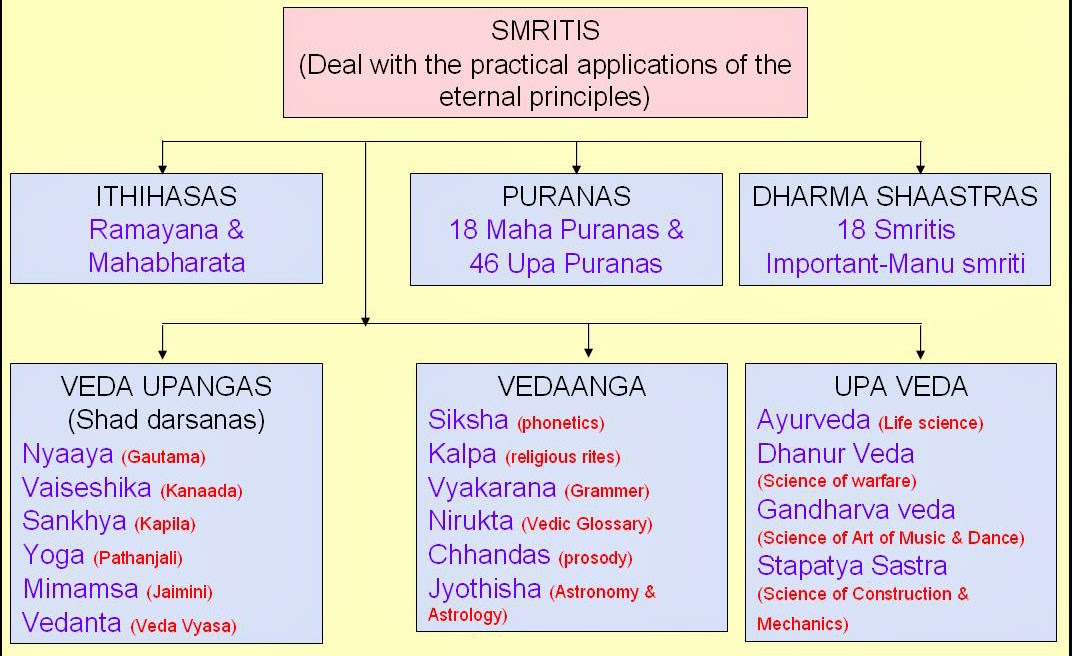
2.    Smritis-(dealing with practical applications of eternal principles)
Srutis:
Under Srutis comes the 4 Vedas namely Rig, Yajur, Sama and Athrava. Each of the 4 Vedas contains Karma Kaanda (3/4parts) and Gnaana Kaanda (1/4 part).  Karma kaanda which occupies the first ¾ part of the Vedas, tells about the mantras and the rituals to be performed and are known as Samhitaas and Brahmanaas.  Gnaana Kaanda which forms the remaining ¼ later part of the Vedas, consists of Aranyakaas and Upanishads.  
However, though the Gnaana Kaanda consisting of Aranyakaas and Upanishads come under aparaa Vidya, since it has graduated to such high levels as to discuss about the Para Brahman,(Supreme God head) this is classified as Paraa Vidya.  Since it is not a strict rule, the mention of the Para Brahman (supreme God head) is found not only in the Aranyakas and Upanishads but sometimes in Brahmanas also and hence even these have to be considered as Paraa Vidya. 

Smritis:
Smrithis are divided into 6 namely Ithihaasa, Purana, Dharma shaastra, Veda Upaanga, Vedaanga and Upa Veda.  
Ithihaasaas:
These are in story forms which contain the essence of the morals and philosophical information contained in the Vedas.  ‘Bhagavat Gita’ which contains 700 slokas, occupies the central part of the Mahaabhaarata and contains the essence of the Upanishads, in simple form. 

Puranas:
Puranas are story forms which contains messages from Vedas. The detailed explanation of Srusti, Sthithi and Samhara (creation, sustinence and annihilation) are a main part of the Maha Puranas.  

Veda Upaanga:
The Veda Upaanga or what is known as the shad dharshanaas, are the philosophical discussions on the nature of Para Brahman (Supreme God head) and hence can be somewhat considered as Paraa Vidya. 

Philosophical thinking:
Indians were given more to rituals and sacrifices. These were elaborated to such an extent by the Brahmanas, (the priestly class) that persons of rationalistic bent of mind revolted and questioned the very efficacy of the sacrificial religion.  This spirit of revolt against ritualism was carried on mainly by the Kshatriyas.  They were very bold thinkers and nothing was sacrilegious to them in their search for truth.  Traces of opposition against the religion of the Vedas are found in the Vedas themselves. 
This tidal wave of retionalism in its extreme form gave rise to such schools of thought as the ‘Chaarvaakaas’, which were extremely materialistic and anti-religious.
In the age immediately preceding Gouthama Buddha and during his life time, there was a great religious and philosophical upheavel in India.  From ‘Brahma jaala Sutra’ we learn that in his time there were as many as 62 different schools of philosophy in India. 
The destructive criticism of everything in the old system by the ‘Chaarvaakaas’ and others, set the orthodox section to organize their belief on a more rationalistic belief. 

This laid foundation of six systems of orthodox Hindu philosophy (Shad Darsanas). Orthodox in the sense that they accepted the authority of the Vedas in things transcendental – while there were others who did not accept this authority and therefore were dubbed as heterodox, though otherwise, they too were the outcome of Upanishadic thoughts. 

The six orthodox shools are
1. Nyaaya
2. Vaisesika
3. Saamkhya
4. Yoga
5. Purva mimaamsa
6. Uttara mimaamsa

We have seen that there were 62 different schools of Philosophy in India.  In general the Indian philosophy is known as Tatwa Darsana. They can be classified as follows.
 The modern day scientists can be classified somewhat under the category of Baudhaas & Vaiseshikas who accept PRATYAKSHA (Perception) and ANUMANA (Inference).

End of Science Story

Scientific story- In search of God particle:
The Nobel Prize for physics in 2013 has been awarded to Peter Higgs and Francois Englert. 
In 1964 - The Nobel laureates came up with the Higgs mechanism. 
The universe was born with a big bang 13.7 million years ago, releasing a lot of energy.  This energy was symmetrical, uniform in space and time.  This symmetry broke 1011 seconds later.  The particles became non-uniform because they had acquired mass.  This was due to the Higgs mechanism.

1. The Universe is pervaded by an invisible field of energy: The Higgs field. Higgs boson, the smallest disturbance in it. 
2. Higgs bosons couple to and retard fundamental particles moving through the field, giving them mass. 
3. For Higgs mechanism to occur, 4 particles were necessary.  Electroweak forces swallowed 3. The only survivor is this Higgs Boson.
4.  (LHC) Large Hadron Collider found the Higgs boson beyond reasonable doubt in January, 2013. 


Before everyone slowly forgets, the "boson" in the "Higgs boson"  the particle was named after Shri. Satyendra Nath Bose.

Satyendra Nath Bose 
At a conference in Kolkota in September 2012, Rolf-Dieter Heuer, Director General of the European organisation for Nuclear Research (CERN-which conducted the Large Hadran Collider experiment) said, “I always spell boson with a capital letter.” He was responding to demands from a section of Indian academia for the ‘B’ in ‘bosons’ to be capitalised, just as ‘H’ was in ‘Higgs boson’. Satyendra Nath Bose’s name was conferred on the class of particles called Bosons, colloquially called force-carriers, by Paul dirac, a contemporary British physicist, in honour of Bose’s collaborative work with Albert Einstein in defining the properties of such particles in the 1920s. 
At CERN the focus is on a theory of particle physics called the Standard Model, which deals with six kinds of bosons, six kinds of leptons, six kinds of quarks, not to mention at least 49 other less significant elementary particles. That is a totally different story and we will deal with it in a different topic. 

Remaining questions – In Scientific story:
Though finding the Higgs boson is a remarkable achievement – and one which Higgs once said he never expected to see in his life time – it is not the end of the story for physicists trying to understand the structure of the universe.  They are now grappling with other mysteries, such as the nature of dark matter that account for more than a quarter of the universe and dark energy that is believed to be the driver of cosmic expansion.  

We have seen from the scientific point of view that our entire Universe started a long time ago, say 13.7 billion years ago, from a point of singularity, the size of less than an atom, in the form of an ultra hot, super energy.  

From the Scientists point of view, still it is not clear, what this point of singularity was.
“The Ultra hot super energy, the size of less than an atom, that burst into a Big Bang.”
What was it? Was it just some Super energy, without any meaning? Or did it have Intelligence? Did it burst of its own free will? Or, is it due to the will of something/ somebody else? These are some of the unanswered questions of Science.  Scientists do not believe in God and hence to them this is just a “Particle”, with no meaning.  


View of Albert Einstein:
Albert Einstein said, “I have repeatedly said that in my opinion the idea of a personal God is a Childlike one. You may call me agnostic, but I do not share the crusading spirit of the professional atheist whose fervour is mostly due to a painful act of liberation from the fetters of religious indoctrination received in youth. I prefer my attitude of humility corresponding to the weakness of our intellectual understanding of nature and of our own beig”.  Einstein further said, “In view of such harmony in the cosmos which I, with my limited human mind, am able to recognize, there are yet people who say there is no God. But what really makes me angry is that they quote me for the support of such views.  (Published in the daily newspaper “THE HINDU” dated Sunday 13th October, 2013 – Open Page.)
                                        * * * * * * * *
According to NASA (which is by no means a religious Institution): “More is unknown than known. It turns out that roughly 68% of the universe is dark energy. Dark matter makes up about 27%. The rest-everything ever observed with all of our instruments, all normal matter-adds upto less than 5% of the universe. Come to think of it, maybe it should not be called ‘normal’ matter at all since it is such a small fraction of the universe.”                                            ( http://science.nasa.gov/astrophysics/focus-areas/what-is-dark-energy/ ) from an article by Shri.K.R.Srivarahan, published in the daily newspaper “THE HINDU” dated Sunday 13th October, 2013 – Open Page.

Einstein's quote: 
"Science without religion is lame, and religion without Science is blind."
                                  * * * * * * * * *

View of Swami Chinmayananda
In Vedanta we do not believe that creation started at any known point in time.  This would be illogical and unacceptable to any awakened thinker.

Time can express itself only in a mind that experiences. In deep sleep, there is no concept of time.  Time cannot be perceived and experienced unless there is a field of objects - the world.  If we say that creation started, at let us say, "21st September" (creation hour) 21st September can have any sense or meaning, only with reference to 20th September (when creation was not). This would be absurd, as time itself is a created, perishable concept.  

To avoid these logical contradictions, the only way we can say when creation started would be 0 second, 0 minute, 0 hour, 0 date, 0 month, 0 year.  Time is the space between two experiences.  So the first unit of time gets created only with the second experience, which means that creation has already come to pass (in the first experience). The concept of time was non-existent in the first experience.  this idea is more beautifully and scientifically put when we say that "The creation is beginningless, it is absurd to think of the first creation. According to Vedanta, there is no creation in the sense of something having come out of nothing. God is himself both the material and the efficient cause of the universe.  There was no first cycle. Time is infinite.  

Why did God create the Universe?
Such questions are logical absurdities!  Reason exists in nature.  Beyond nature, it has no existence. God is omnipotent, hence to ask why he did this or that is to limit him: for it implies that he must have had a purpose, it must be a means to an end, and this would mean that he could not have the end without the means.  Then questions, "why and wherefore", can only be asked of something else.  The perfection of god is unlike any finite perfection. 

Conclusion: 
Since the topic of this article is “In search of God Particle”, from the scientific point of view, it ends here, without giving an answer to any of the questions raised.  

The continuation to this article in book-2, will be titled “In search of Supreme God”, where the “The Ultra hot super energy, the size of less than an atom, that burst into a Big Bang” is explained as “Para Brahman” by the ‘Puranas’, ‘Bhagavat Gita’ and the Upanishad part of the Vedas. And this will answer all the questions that have been asked…. like…
Where did we come from?
Where are we?
Where is our end? and
Why are we here.  

Still a long way to go to “Vaikundam”! 
Please follow me patiently, to see “Vaikundam” 

This is a new addition to this post dated 03-09-2021
I heard a lecture by Shri.Shri. RaviShankar swamy and here is the lecture which is very similar to this topic and with quotes from Vedas. Click the link below to see video. 


I have started a new blog http://insearchsupremegod.blogspot.com which is a continuation to this blog. please follow that blog which will be updated everyweek. link is provided from below also.  

I have been updating this blog often.....
Now the date is 26th February 2022. 
As new discoveries are made in Science & Technology new perception are coming in and here is one.....

Surprise: the Big Bang isn’t the beginning of the universe anymore

We used to think the Big Bang meant the universe began from a singularity. Nearly 100 years later, we're not so sure. For more details see in the link below. 

Here is some more news from the Scientific world.....
Hans Peter Duerr (1929-2014)was a nuclear physicist, Director of Max Planck Institute and close associate of Heisenberg. He was a proponent of the principle of uncertainty. He specialised in quantum physics, elementary particles, gravitation, epistemology and philosophy. He seems to have been very impressed by the Indian concept of Maya.
Now I seriously think whether we should revisit the Vedantic wisdom. Is the principle of uncertainty and quantum mechanics same as the Hindu concept of Maya stitched with mathematical muscles?


Here is another version of the latest interpretation of Higgs Boson.....


Do Aliens exist ....? ISRO Chairman Dr.Somnath says "Aliens are Real"
watch this mind bogging Interview....


5 Mysterious real recordings of the "SOUND OF THE UNIVERSE"

1. Sound of the Space 13.7 Billions years before.

2. Sound of Massive Black hole.

3. Sound of Neptune.

4. Sound of a Star

5. Sound of Inter-stellar space.

Hear in the link below

https://www.youtube.com/watch?v=wN3mYEpPUOM 


I found this question from
one of the respected Professors of IIT Madras is very interesting.